 BEA Summit is Live
BEA Summit is Live
BEA Summit is Live
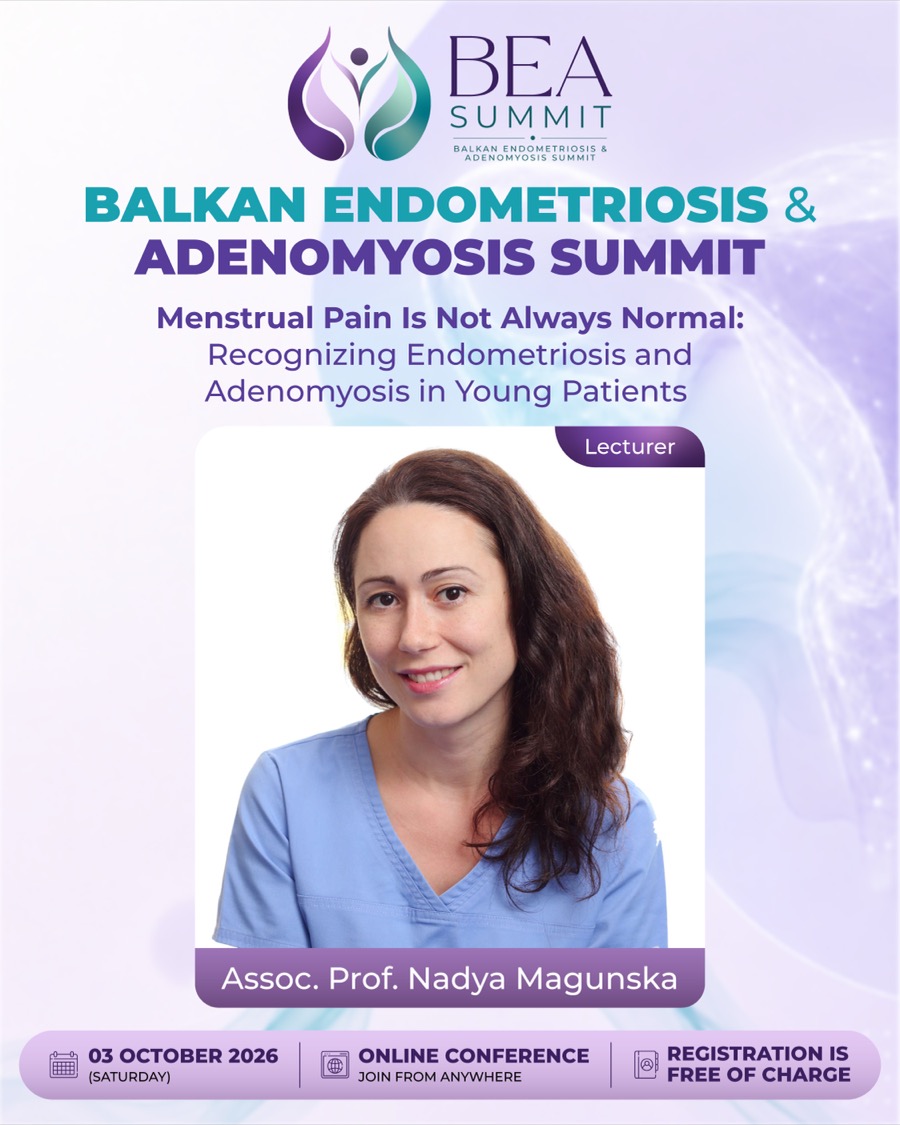
Assoc. Prof. Nadia Magunska is an obstetrician-gynecologist and minimally invasive surgeon with over 15 years of experience in the diagnosis and treatment of endometriosis. She heads the Endometriosis Center at Dr. Shterev Hospital. She is the recipient of the “Golden Hippocrates” Award, holds a Ph.D. on infertility associated with ovarian endometriosis, and has completed fellowships at leading European centers for reproductive and endoscopic surgery. Her clinical and scientific work focuses on minimally invasive surgical techniques, improving fertility outcomes, and refining diagnostic approaches, which earned her recognition from the Bulgarian Medical Association for innovative medicine in 2025. Alongside her surgical practice, she actively trains specialists and works to promote the early detection of menstrual and reproductive issues in girls and young women.
On 3 October 2026, Dr Magunska will join the Balkan Endometriosis & Adenomyosis Summit 2026 - a free, online conference in English bringing together leading specialists and patient organisations from across the region.
The interview with Associate Professor Nadia Magunska reveals how early academic recognition and international specialisation have shaped her approach to modern, minimally invasive surgery for endometriosis. She emphasises the importance of multidisciplinary care, personalised fertility solutions and careful surgical planning, particularly in cases of ovarian endometriosis. The interview also outlines the future of care in Bulgaria – earlier recognition of symptoms, training for specialists and the introduction of innovative diagnostic methods for young patients.
I have always had a passion for learning and expanding my knowledge. I find this field of medicine particularly fascinating because it is constantly evolving, with new scientific evidence emerging every day and opportunities to incorporate innovative technologies into clinical practice.
A multidisciplinary approach to the disease is a cornerstone for appropriate management and for minimizing the impact of severe forms of endometriosis. I strongly believe that competent professional support addressing every aspect of how the disease affects patients is essential for their overall well-being and quality of life.
Ovarian endometriosis is perhaps the form of the disease that clinicians are most familiar and comfortable with, and it may appear relatively straightforward to treat. However, from a reproductive perspective, it requires particularly careful consideration, as both the disease itself and its surgical treatment may have a significant impact on ovarian reserve and future fertility.
It is therefore essential for clinicians to recognize that an endometrioma is not simply a benign ovarian cyst to be removed, but rather a manifestation of a more complex and extensive disease. The decision to operate should always be individualized and carefully balanced against the potential risk of compromising ovarian reserve. Preserving future reproductive potential should be a key consideration, particularly in young women of reproductive age and in those who have not yet completed their family planning.
I have been fortunate to visit and train at several leading centers for minimally invasive gynecologic surgery, and these experiences have truly broadened my perspective as a surgeon and shaped my understanding of modern gynecologic surgery. They have taught me that, with continuous training and dedication, a minimally invasive approach can be applied to almost every field of gynecologic surgery, allowing our patients to benefit from its many advantages.
From every center I have visited and every “master of our craft” I have had the privilege to learn from, I have picked up something—sometimes a major surgical principle, sometimes a small technical trick. Over the years, these lessons have become part of my own surgical practice, making my work in the operating room more precise, efficient, and ultimately better for my patients.
We should never forget that endometriosis is a benign disease that affects many young women. The primary goal of our treatment is to improve our patients’ quality of life. At the same time, we know that the more extensive and radical a surgical procedure becomes, the greater the surgical trauma and the potential risk of complications and long-term impairment of quality of life.
In my view, an endometriosis surgeon should therefore focus not simply on achieving the most radical excision possible, but on finding the right balance between adequate disease removal and minimizing surgical trauma. This requires careful tailoring of the extent of surgery to each individual patient. Incorporating surgical techniques and technologies that help us achieve greater precision, preserve healthy tissue and organ function, and reduce unnecessary surgical morbidity is therefore an essential part of modern endometriosis surgery.
First and foremost, we need to educate a broader range of clinicians, particularly those involved in preventive and primary care, to recognize the symptoms of endometriosis, understand its different manifestations, and be familiar with the appropriate diagnostic approaches.
Equally important is raising awareness among young women that living with pain should not be considered normal. They should be encouraged to recognize persistent or severe pain as a reason to seek medical attention rather than simply accept it as part of their everyday lives.
Young people are generally physically and socially active, and when a young woman starts changing or adapting her everyday life because of pain—giving up activities, limiting her social life, or planning her daily routine around her symptoms—I consider this an important warning sign that should not be overlooked.
I look forward to a new generation of physicians with a much deeper understanding of endometriosis—its diverse clinical manifestations, early recognition, and appropriate management. I believe that timely adoption of effective diagnostic innovations will allow us to diagnose endometriosis sooner and provide our patients with more individualized and effective care.
Register free to attend Assoc. Prof. Nadya Magunska’s session and the full BEA Summit 2026 programme.
Register Now