 BEA Summit is Live
BEA Summit is Live
BEA Summit is Live
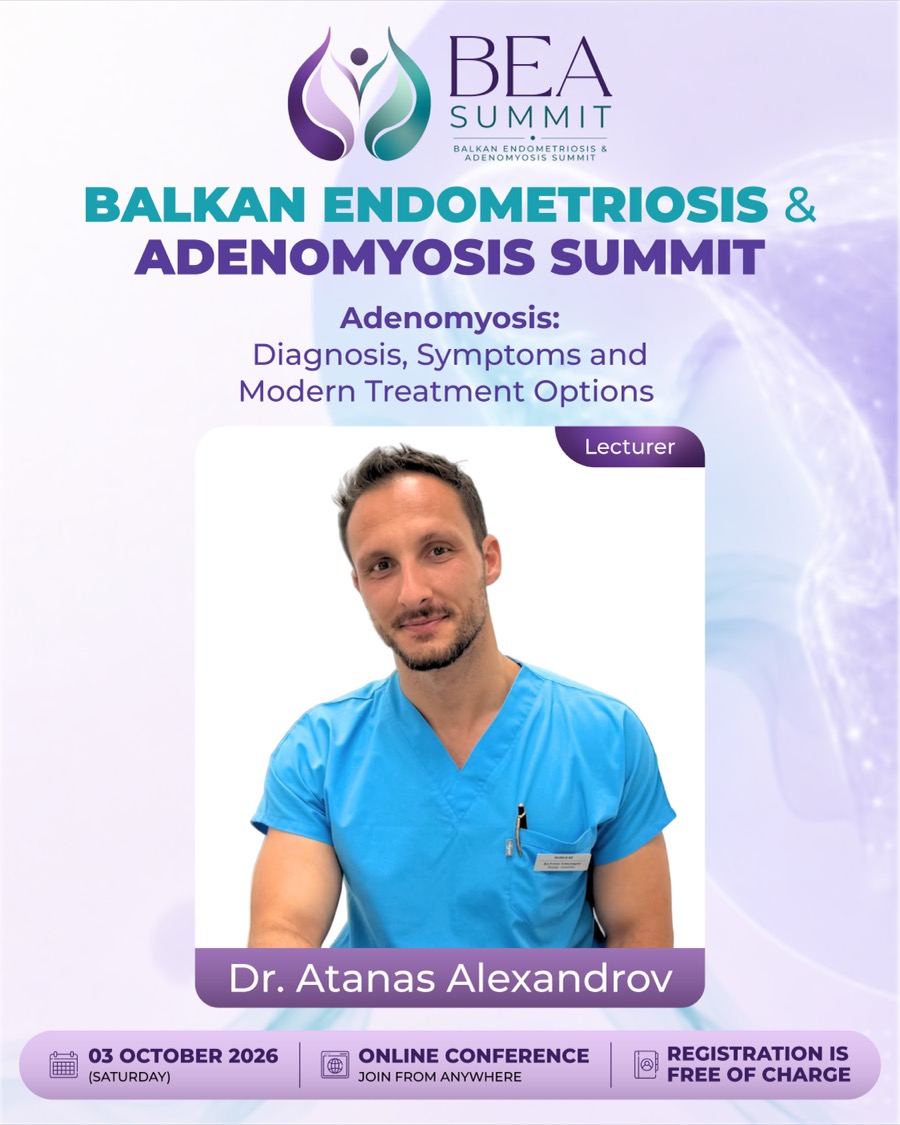
Dr Atanas Alexandrov is an obstetrician-gynecologist who specializes in minimally invasive surgery, endometriosis treatment, and reproductive medicine. He graduated with honors from the Medical University of Varna and completed his residency in Bulgaria and at leading European centers in France, Belgium, and Italy, including training under Prof. Horace Roman. Alexandrov holds a GESEA MIGS diploma and serves as chief mentor at the ESGE-certified SIMLAB GESEA Training Center in Pleven, as well as a member of the ESGE Advisory Board and the Neuropelvology Group. His clinical interests include endometriosis, reproductive surgery, and hysteroscopy, while his research focuses on nerve-related complications in advanced pelvic surgery.
On 3 October 2026, Dr Alexandrov will join the Balkan Endometriosis & Adenomyosis Summit 2026 - a free, online conference in English bringing together leading specialists and patient organisations from across the region.
The conversation with Dr. Alexandrov explores how his international experience at leading European centers has shaped his philosophy toward individualized and function-oriented surgery for endometriosis. He discusses the importance of a multidisciplinary approach, the role of neuropelviology, and careful planning that combines treatment with the preservation of function. The interview also outlines the future of care in Bulgaria—earlier diagnosis, specialized centers, and standardized training.
International training has probably been one of the strongest influences on the way I approach surgery today. Working in different European centres showed me that there is rarely only one correct surgical technique. What matters is understanding anatomy, understanding the disease and being able to adapt the operation to the individual patient.
My experience in France was particularly important. I learned to look beyond simply removing visible disease and to think about the pelvis as a functional anatomical unit. In complex surgery, radicality alone is not the goal. The real objective is to achieve adequate treatment while preserving function and quality of life. This philosophy applies not only to endometriosis, but also to reproductive surgery, pelvic floor surgery and oncological procedures.
One of the most important lessons was that advanced endometriosis should be treated as a genuinely multidisciplinary disease. When the bowel, urinary tract, pelvic nerves or other structures are involved, successful surgery depends not only on the individual surgeon but on the entire team.
Working with Prof. Horace Roman also reinforced the importance of tailoring surgery to the actual disease rather than applying the same operation to every patient. Sometimes the best surgery is extensive excision; in another patient, a more conservative approach may provide the best balance between symptom control and preservation of function. Good endometriosis surgery is therefore not simply about how much you can remove, but about knowing what should be removed, what should be preserved and why.
For me, fertility preservation starts before entering the operating room. We need to understand the patient's age, ovarian reserve, reproductive plans, previous surgery and the exact distribution of the disease before deciding how aggressive surgery should be.
This is particularly important in ovarian endometriosis and recurrent disease, where repeated surgery can significantly affect ovarian reserve. The technically most radical operation is not necessarily the best operation for a woman who wants to become pregnant. At the same time, inadequate surgery can leave pain, distorted anatomy or disease that itself compromises fertility. The challenge is finding the correct balance. Whenever possible, my goal is to restore anatomy, remove clinically relevant disease and minimise unnecessary damage to healthy reproductive tissue.
They influence it enormously because they constantly expose me to different surgical philosophies, new techniques and colleagues from across Europe. ESGE provides an environment where we can discuss not only how surgery is performed, but also how it should be taught, evaluated and standardised.
GESEA is particularly important to me because I strongly believe that advanced surgery cannot be learned simply by watching operations. Training has to be structured and progressive — starting with anatomy and simulation, developing laparoscopic and suturing skills, and only then transferring those skills safely to the operating room.
Neuropelveology adds another dimension. It forces us to understand pelvic anatomy beyond the organs themselves and to consider the nerves responsible for bladder, bowel, sexual and motor function. That knowledge has changed the way I approach many complex pelvic procedures.
The pelvic nerves are probably among the most underestimated structures in advanced gynaecological surgery. Deep endometriosis can directly infiltrate or compress nerves, but neurological dysfunction can also result from surgical injury during difficult dissections.
For surgeons, this means that detailed knowledge of retroperitoneal and pelvic neuroanatomy is becoming increasingly important. We should be able to identify major neural structures and, whenever oncologically and surgically appropriate, preserve them.
For patients, it is important to understand that symptoms such as bladder dysfunction, altered bowel function, sexual dysfunction or even pain radiating towards the leg may sometimes have a neurological component. Recognising this before surgery allows us to plan the operation more
accurately and to have a much more meaningful discussion about expected outcomes and potential risks.
I don't really see them as completely separate areas. A patient with infertility or chronic pelvic pain may simultaneously have endometriosis, adenomyosis, fibroids, intrauterine pathology or distorted pelvic anatomy. If we look at only one part of the reproductive system, we can easily miss the bigger picture.
Hysteroscopy gives us access to the uterine cavity, reproductive surgery allows us to restore pelvic anatomy, and advanced laparoscopy or robotic surgery allows us to treat complex disease while remaining minimally invasive. My experience in oncological and pelvic floor surgery also contributes significantly, because many of the same principles — precise anatomical dissection, retroperitoneal anatomy, ureterolysis and preservation of nerves and vascular structures — are directly applicable to difficult endometriosis surgery.
Ultimately, the goal is not to perform a particular procedure. It is to understand what is preventing that particular woman from achieving the outcome she wants and choose the least destructive effective treatment.
Adenomyosis remains challenging because it is not a single uniform disease. It can be diffuse or focal, superficial or deep, and its clinical presentation varies enormously. Some women have severe dysmenorrhoea and heavy menstrual bleeding, others present primarily with infertility, and some have relatively limited symptoms despite significant imaging findings.
Modern ultrasound and MRI have dramatically improved our ability to diagnose adenomyosis without hysterectomy, but imaging findings always need to be interpreted together with symptoms, age and reproductive plans.
Treatment is increasingly individualised. Hormonal therapies, particularly progestin-based approaches and the levonorgestrel intrauterine system, remain important. GnRH-based treatments also have a role in selected patients. At the same time, uterus-preserving surgery is developing for carefully selected women with focal or severe disease who wish to maintain fertility. Non-surgical technologies such as HIFU and other image-guided treatments are also interesting, although patient selection and long-term evidence remain crucial.
I think the future of adenomyosis treatment will not be one single superior technique, but much better phenotyping of the disease and matching the right treatment to the right patient.
I think Bulgaria has the potential to make a significant step forward. We already have highly motivated specialists and increasingly good access to advanced laparoscopy, robotic surgery and modern imaging. The next step is to organise this expertise more systematically.
For complex endometriosis in particular, I believe the future belongs to specialised multidisciplinary centres where gynaecologists work closely with colorectal surgeons, urologists, radiologists, reproductive specialists, pain specialists and, when necessary, specialists familiar with pelvic nerve pathology.
At the same time, we need better awareness and earlier diagnosis. A woman should not have to spend many years moving between different specialists before somebody recognizes that her symptoms may be caused by endometriosis or adenomyosis.
My hope is that over the next decade we move away from isolated individual expertise towards structured centres, standardised training and multidisciplinary care. If we achieve that, Bulgarian patients should not need to travel abroad to receive the same level of complex endometriosis care available in leading European centres.
Register free to attend Dr. Atanas Alexandrov’s session and the full BEA Summit 2026 programme.
Register Now